Care for a million people
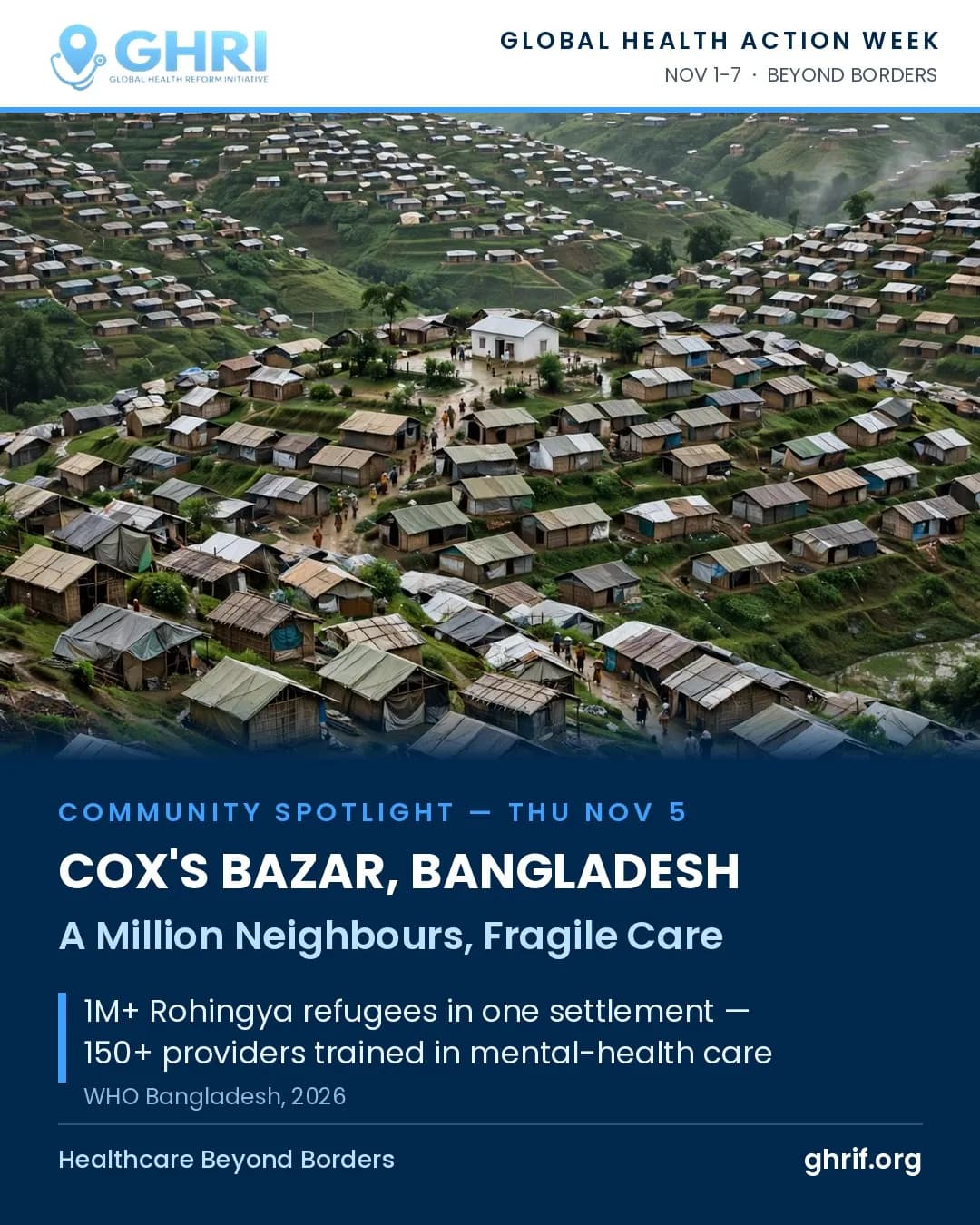
Cox's Bazar hosts more than one million Rohingya refugees — one of the world's largest refugee settlements. WHO's 2026 reporting shows essential health services under mounting pressure: funding constraints threaten disease surveillance, outbreak response, and the continuity of basic care.
In a settlement this dense, healthcare is not only treatment — it is prevention at scale. When surveillance or vaccination falters, outbreaks move fast.
A response that adapts
The response is adapting: Bangladesh's government, with WHO's technical leadership and EU support, is shifting to integrated, person-centred care. Over 150 primary-care providers have been trained in mental-health care — and around 1 in 10 households includes someone living with a mental-health condition, a quiet crisis now being met more openly.
That last part matters. Displacement wounds minds as well as bodies, and care that ignores mental health is only half care.
Why we're spotlighting Cox's Bazar
Refuge should never mean the end of healthcare. GHRI is highlighting Cox's Bazar to raise awareness — of the scale of need, the fragility of the funding behind the response, and the quieter work of meeting it with dignity.
Statistics: WHO reporting on health services in Cox's Bazar (2026).
Access to health care for all.
GHRI is building telemedicine, mobile health units, and patient transportation for underserved and rural communities — powered by volunteers. Join us, or support the mission.
The GHRI Team
GHRI
GHRI is building digital infrastructure — including an automated Triage AI system and a secure telemedicine platform — to eliminate administrative barriers, optimize volunteer-led medical care, and expand healthcare access for underserved and rural communities.